Clause 10Melt-Through Symbol
How to read the melt-through symbol — the filled (solid) semicircle indicating CJP with visible root reinforcement from one side. Tubular connections, HSS joints, and one-sided CJP applications.
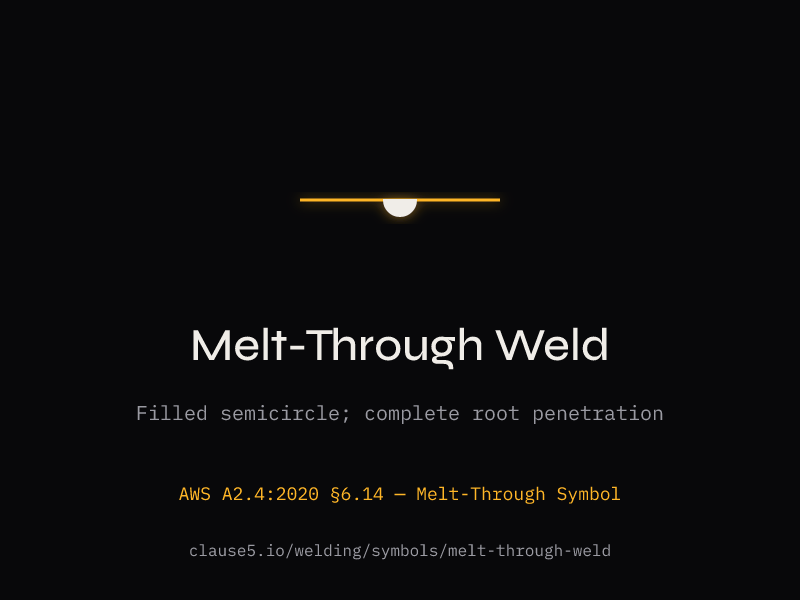
Melt-Through Symbol Placement
Per AWS A2.4 §6.14, the melt-through symbol is a supplementary symbol — a filled (solid black) semicircle placed on the opposite side of the reference line from the groove weld.
Root Reinforcement Height
Shown to the LEFT of the melt-through symbol, on the opposite side from the groove weld. When omitted, visible root reinforcement is required but no specific height is mandated.
One-Sided Welds Only
The melt-through symbol applies only to welds made from one side. If you can weld from both sides (with backgouge or back weld), melt-through is not the correct symbol — use the back/backing weld symbol instead.
Common Applications
Pipe/tube penetrations welded from the outside only. HSS through-plate connections where inside access is impossible. One-sided CJP joints without backing bars. Edge welds on flanged joints combined with the melt-through symbol for CJP.
Clause 10: Tubular connections are the primary D1.1 application for melt-through. HSS-to-plate and round-to-round connections where the inside surface is inaccessible frequently specify CJP with melt-through.
Melt-Through Symbol FAQ
Clause 10 governs tubular connections where melt-through is common. Typical applications include pipe or tube penetrations welded from the outside only, HSS (hollow structural section) through-plate connections, and one-sided CJP joints where backing bars are impractical. The melt-through symbol can also combine with edge weld symbols for CJP flanged joints welded from one side.