AWS A2.4 Section 13.1 · Flanged JointsEdge Weld Symbol
The edge weld symbol appears in AWS A2.4 Figure 4.1 and is defined for parallel and flanged joints by AWS A2.4 Section 13.1. When CJP is required on flanged joints, AWS A2.4 Section 13.4 combines it with melt-through on shop drawings.
How to read an edge weld symbol — the three capped vertical lines indicating a weld joining flanged or parallel edges. Common in sheet metal, less common in structural steel. When to combine with melt-through.
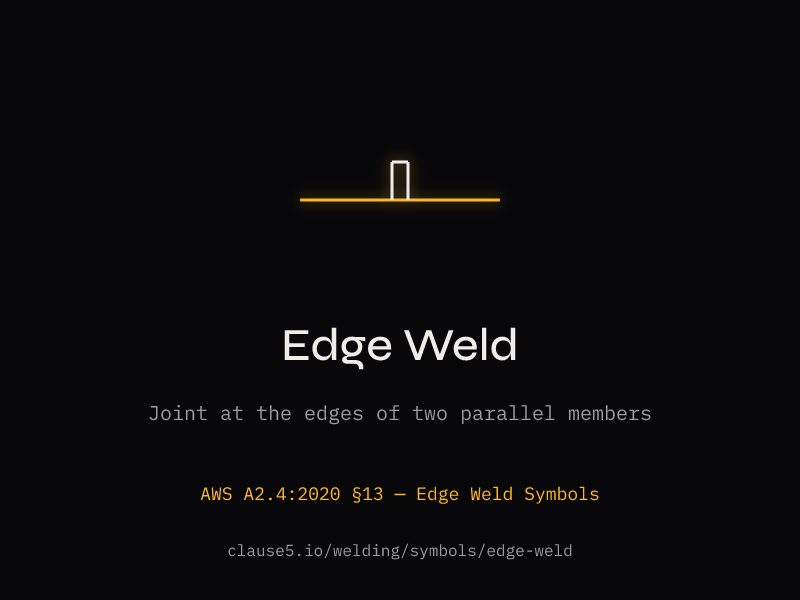
Edge Weld Symbol Dimensions
Per AWS A2.4 Figure 4.1, the edge weld symbol is three short parallel vertical lines on the reference line, joined by a cap at the end away from the line. Per AWS A2.4 Section 13.1, it represents a weld that fuses the full thickness of both member edges.
Use this symbol only when the joint really is an edge-weld condition: parallel edges, a flanged butt joint, or a flanged corner joint. If the drawing is calling for prepared butt-joint geometry, a square groove or another groove weld symbol is usually the cleaner AWS A2.4 reference. The edge weld symbol should not be used as a shortcut for the two-line square groove symbol.
Where Each Dimension Goes
Size — to the LEFT when specified. This is the weld width or buildup thickness.
Length — to the RIGHT. The extent of the edge weld along the joint.
Joint Types
Parallel edge joint — two members with edges aligned side by side. The weld fuses the edges together.
Flanged butt joint — thin members with edges flanged (bent) to create a preparation for welding from one side.
Flanged corner joint — one or both members flanged at a corner. The flange creates material for the weld.
Combining with Melt-Through
When CJP is required on a flanged joint welded from one side, add the melt-through symbol (filled semicircle) on the opposite side of the reference line per AWS A2.4 Section 13.4. This combination tells the welder that full penetration with visible root reinforcement is required.
The melt-through symbol is the important quality cue. Without it, the edge weld symbol identifies the joint and weld type, but it does not by itself prove complete joint penetration. When inspection requires back-side evidence, make the melt-through requirement explicit and verify the finished root condition against the governing drawing or procedure before accepting production welds at closeout and final documentation review.